You've spent $15,000 on a video. The production value is excellent. Engagement metrics look solid. And your conversion rate is 0.8%.
The problem isn't your message or your audience or your distribution. The problem is you're treating the call to action like an afterthought instead of the strategic centerpiece it actually is. Most businesses bolt a CTA onto the end of their video and wonder why nobody takes action. That approach fundamentally misunderstands how conversion psychology works.
Decision fatigue is real and measurable. Research from Columbia University shows that when people face too many choices or unclear next steps, their brains default to inaction. It's a protective mechanism. When the path forward isn't crystal clear, doing nothing feels safer than potentially making the wrong choice.
This explains why your beautiful video with the vague ending ("Visit our website to learn more") generates zero conversions. You've asked viewers to figure out what happens next. That cognitive load triggers the same avoidance response as complex decisions about retirement planning or health insurance. Their brain says "I'll deal with this later" and they scroll past.
Effective conversion architecture removes that friction entirely. The viewer should know exactly what action to take, why they should take it now, and what outcome they'll receive. When those three elements align, conversion becomes the path of least resistance.
After producing over 10,000 videos and tracking actual revenue generated, we've identified a conversion framework that consistently outperforms standard approaches. It's based on behavioral economics research, not marketing opinions.
First principle is singular focus. Your video should drive toward one conversion action, not three. Multiple CTAs create decision paralysis. We've tested this exhaustively. Videos with two competing CTAs ("Download our guide or schedule a consultation") convert 40% worse than videos with one clear directive. Your viewer's attention is finite. Spend it on one high-value action.
Second principle is strategic placement timing. Industry research shows CTA conversion rates vary dramatically based on video length and placement. For videos under 60 seconds, CTAs placed in the first quarter convert best. For videos between one and three minutes, mid-roll placement during peak engagement works better. For longer content, you need multiple touchpoints but the same CTA repeated at natural decision moments.
The psychology is straightforward. Attention peaks at specific moments during video consumption. At the beginning when curiosity is highest. After a key insight or reveal when interest is triggered. At natural conclusion points when the viewer is looking for next steps. Strategic placement means appearing at those exact moments with your singular conversion ask.
Third principle is value-first framing. Your CTA language should emphasize what the viewer receives, not what you want them to do. "Get instant access to our pricing calculator" outperforms "Contact us for pricing" by measurable margins. The first frames the action around their benefit. The second frames it around your desired outcome.
This isn't semantic wordplay. It's addressing the fundamental question every viewer asks unconsciously: "What's in this for me right now?" If your CTA doesn't answer that question immediately and specifically, conversion rates tank.
CTA design and placement aren't creative decisions. They're engineering problems with measurable solutions. Button color, size, contrast, and positioning all impact conversion rates in predictable ways.
Analysis of 36,000 video CTAs shows the average conversion rate across platforms hovers around 16%. But that average hides massive variance. Original series content and sales videos convert at 25% or higher. Generic promotional videos struggle to hit 8%. The difference is strategic CTA integration versus bolt-on afterthoughts.
For corporate video production, this means planning the CTA before you shoot anything. The entire video structure should build toward that moment. Every section should reinforce why the action matters and remove objections that might prevent conversion.
We script videos backwards. Start with the conversion moment and the exact language we'll use. Then build the content that makes that ask feel logical and necessary. Most video production teams in Greenville do the opposite. They create content and then try to attach a relevant CTA. That approach generates the 0.8% conversion rates that waste marketing budgets.
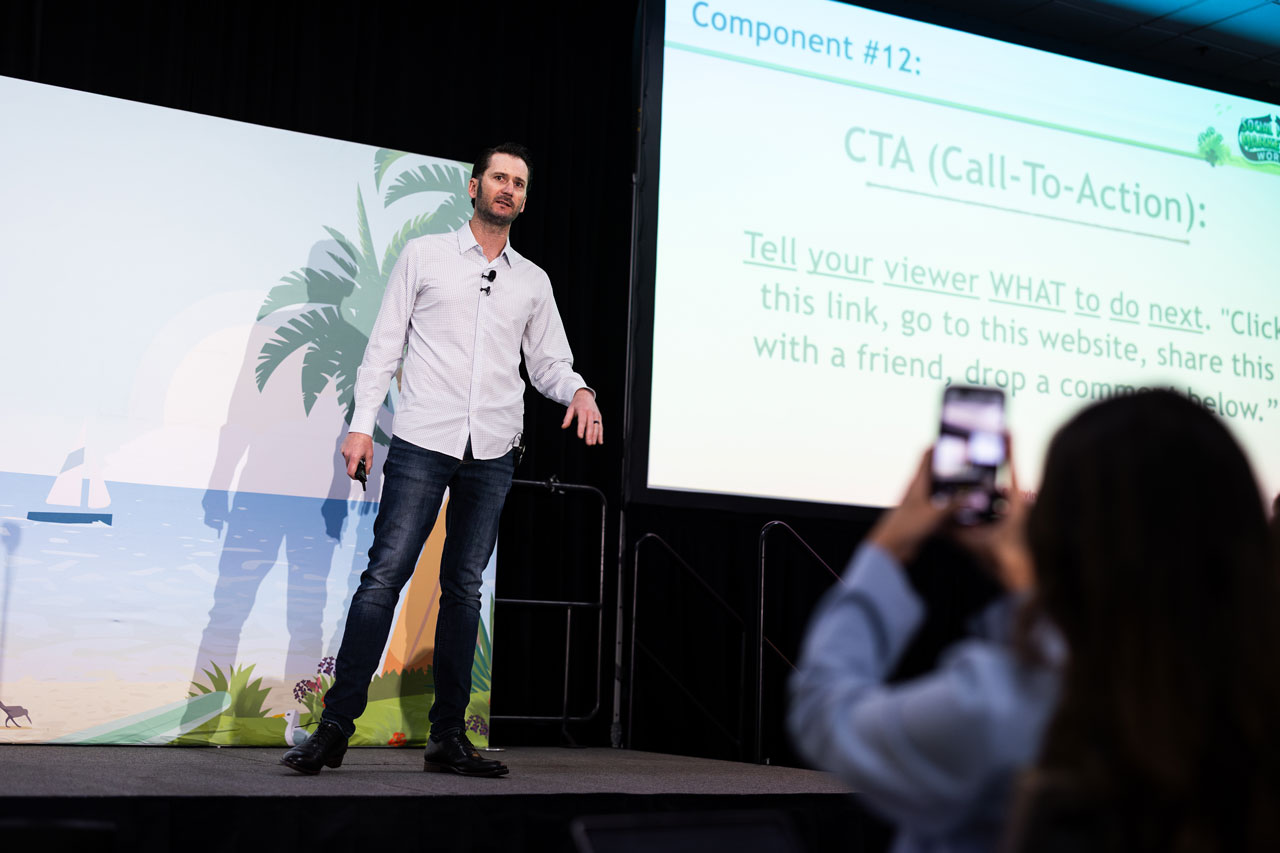
Biggest mistake is vague action language. "Learn more" is not a CTA. It's a placeholder that triggers zero urgency. Specific, outcome-focused language works: "Download the 2026 pricing guide," "Reserve your consultation slot," "Get instant access to the calculator." Those phrases tell viewers exactly what happens when they click.
Second mistake is misaligned landing pages. Your video promises one thing. The landing page delivers something different. That disconnect destroys conversion instantly. If your video CTA says "See how companies reduce video costs by 60%," the landing page needs to show exactly that, not a generic services overview.
We've tracked this extensively. Even small mismatches between video message and post-click experience drop conversion rates by 40% or more. The viewer feels tricked. Their brain registers the inconsistency and defaults to leaving rather than risk being misled.
Third mistake is ignoring mobile optimization. Over 70% of video views happen on mobile devices. If your CTA button is too small to tap easily, if your landing page isn't responsive, if the form requires desktop functionality, you've eliminated most of your potential conversions before anyone tries.
Fourth mistake is measuring the wrong metrics. View count and watch time tell you nothing about conversion effectiveness. The metrics that matter are click-through rate on your CTA, completion rate of the desired action, and revenue generated per video view. Those numbers reveal whether your video is actually working as a conversion tool.
When businesses evaluate video production or search for video editing services, they typically assess portfolio quality and production capabilities. What they should be evaluating is whether the team understands conversion architecture and can engineer videos that drive measurable business outcomes.
Anson Creative has been producing high-converting videos for 21 years because we treat every project as a conversion engineering challenge. Before we write a script or plan a shoot, we map the conversion framework. We identify the single highest-value action. We determine the optimal placement timing based on content length. We craft value-first CTA language that removes friction and creates urgency. To understand why our experience in video production translates to better conversion rates, you need to see the results this framework generates across our production examples.
That strategic foundation determines whether your video generates leads and revenue or just accumulates views. The difference isn't creativity or production budget. It's understanding that video conversion is a technical discipline with proven principles that either get applied or don't.
Related reading: Video Marketing Qualifying Framework · Facebook & Instagram Video Ads: Hook Rate Optimization