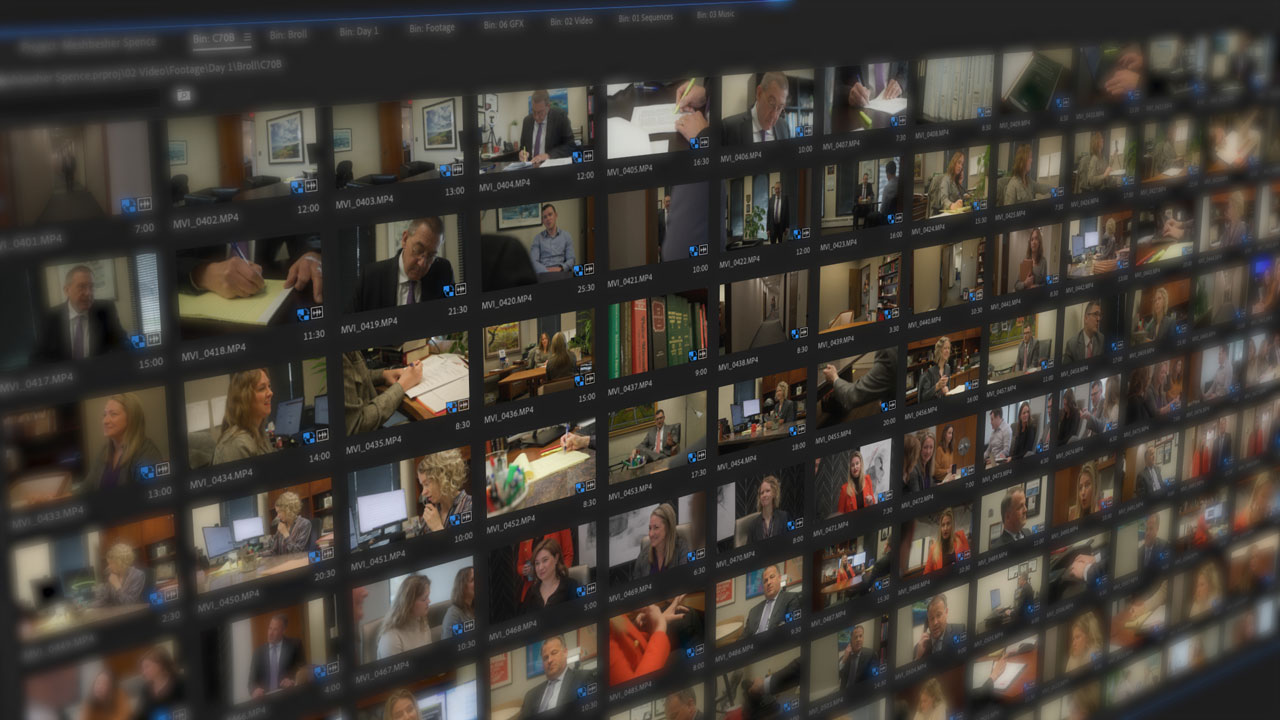
Here's why most corporate videos feel boring: 90% talking head, 10% random B-roll of someone typing on a laptop or walking down a hallway.
The B-roll doesn't support the story. It's just visual filler to cover jump cuts, shot with no strategic purpose beyond "we need something to show while they're talking."
After producing over 10,000 videos for companies selling everything from SaaS platforms to coaching programs to physical products, we've learned that B-roll isn't about making your video look professional. It's about making abstract concepts concrete so the viewer's brain can process and retain information.
When someone explains "we help companies streamline their operations," the viewer's brain tries to visualize what that means. If you show them random office footage, their brain gives up and checks out. If you show them specific visual metaphors (cluttered desk transforming into organized workflow, scattered documents becoming digital systems), their brain locks onto the concept and retention jumps 40%.
Here's the framework we use to shoot B-roll that actually drives conversion instead of just filling screen time.
Amateur producers think B-roll is one thing. Professional producers understand there are three distinct types, each serving a specific neurological purpose.
Type 1: Literal Illustration B-Roll
This shows exactly what the speaker is describing. When your CEO says "we've helped over 500 companies," you cut to a montage of client work, office environments, or team members working on projects. The brain receives verbal and visual information simultaneously, doubling retention. This is the most straightforward B-roll type and the one most companies attempt to execute, usually poorly.
Type 2: Metaphorical B-Roll
This is where amateur and professional productions diverge most dramatically. When your software company's CTO explains how your platform "eliminates bottlenecks," literal B-roll would show servers or code. Metaphorical B-roll might show water flowing freely through pipes, a traffic jam suddenly clearing, or a cluttered workspace transforming into organized efficiency. The brain processes metaphor faster than literal description, especially for abstract concepts. This is why the best tech company videos use almost no footage of actual technology.
Type 3: Emotional Context B-Roll
This creates the emotional atmosphere that makes your message land. Before your client testimonial about how your service "changed everything," you show quiet morning light through office windows, a team celebrating around a whiteboard, hands shaking on a deal. None of this footage illustrates the testimonial content. It primes the viewer's emotional state so the words hit harder. This is the B-roll type that separates videos that make people feel something from videos that just inform people.
Most shot lists are organized by location: office shots, product shots, team shots. This creates efficient shooting but ineffective editing. We organize shot lists by function:
Message Support Shots (40% of your B-roll)
Every key message in your script needs three visual options: one literal, one metaphorical, one emotional. This sounds like three times the work until you realize how many times you've watched a final cut where the editor had to use whatever was available rather than what actually served the scene. Planning message support shots upfront eliminates this problem entirely.
Transition Shots (20% of your B-roll)
These shots allow you to move between topics, time shifts, or emotional states. Wide establishing shots of locations, hands moving from one task to another, doors opening, screens changing. Without transition shots, editors cut abruptly between unrelated footage and the visual logic breaks down.
Detail Shots (25% of your B-roll)
Close-ups of products, interfaces, hands working, faces reacting. Detail shots create visual intimacy and allow viewers to examine specific elements. For product demonstrations, detail shots aren't optional—they're the entire point.
Atmosphere Shots (15% of your B-roll)
These establish the visual tone and emotional register of your video. Architecture, environment, light quality, texture. Atmosphere shots are often the first to get cut when schedules run tight, which is why so many corporate videos feel like they were shot in a fluorescent-lit box regardless of their actual location.
The biggest mistake in B-roll production isn't conceptual—it's logistical. Companies let their interview schedule dictate their B-roll schedule instead of the reverse.
Here's how that goes wrong: interviews run long, B-roll time gets compressed, the team rushes through locations grabbing whatever they can. The edit suite then gets footage that's technically competent but strategically useless.
We structure shoots so B-roll gets protected time. Specifically:
Each location gets a dedicated B-roll block before interviews begin. This ensures you're capturing location-specific shots while you have full setup and the location is at its best. Interviews rarely require the location to look perfect. B-roll always does.
The shot list gets divided into "must have" and "good to have" tiers before the shoot. When time compresses (and it always does), the team knows exactly which shots to protect and which to sacrifice.
A dedicated B-roll operator works simultaneously with interview setup whenever possible. This doubles your B-roll capture time without adding shoot days.
After reviewing hundreds of corporate video productions, these mistakes appear consistently:
Generic people-working footage: Someone typing, someone in a meeting, someone on a phone call. This footage exists in every stock library for a reason—it's visually available but strategically meaningless. Viewers' brains have been conditioned to ignore it. When your B-roll looks like stock footage, viewers treat it like stock footage.
Mismatched production quality: Beautiful interview footage cut against handheld B-roll creates visual dissonance. The viewer doesn't consciously notice the mismatch but they feel it as unprofessionalism. Either commit to a consistent visual aesthetic throughout or use the quality differential intentionally (documentary feel, behind-the-scenes authenticity).
B-roll that contradicts the script: Your CEO explains sophisticated enterprise solutions while the B-roll shows a small team in a startup office. Your testimonial client describes a premium experience while the B-roll shows a cramped reception area. These contradictions don't just weaken your message—they actively undermine credibility.
Missing the emotional beat: Most B-roll editors cut on content (this shot illustrates this sentence) rather than emotion (this shot creates the feeling this moment requires). The difference between a video that converts and one that informs is almost always whether the editor understood the emotional architecture of the piece.
If you're working with a video production company, the B-roll brief is where most of the strategic value gets lost. Clients describe locations and activities. Production teams execute what they're briefed on.
A functional B-roll brief includes: the emotional register of each section (what should the viewer feel here?), the abstract concepts that need visual metaphors (what are we trying to make concrete?), the credibility signals that need illustration (what claims need visual proof?), and the transition points that need visual breathing room.
Most clients can't articulate this because they're thinking about content, not psychology. A production company worth hiring should be asking these questions if you're not providing this information upfront.
We've spent 21 years learning which B-roll shots actually support sales narratives and which ones just waste production time. The difference between B-roll that sells and B-roll that fills time is strategic intention.
For more on this, read our guide on pre-production checklist.